Field guide
Pest plants and how to beat them.
These invasive plants smother and kill native bush, taking away habitat and food for native wildlife. Here’s how to recognise them and get rid of them.
Buffer Zone Programme
A park buffer zone is a 500m area surrounding a park with special ecological values. In park buffer zones there are restrictions on selected highly invasive pest plants to prevent them spreading into the parks. These pest plants degrade native habitats by smothering native plants and killing them, removing habitat and food sources for our native animals. By controlling these pests we are helping the native habitats to flourish, supporting healthy ecosystems and a wide range of Auckland’s wonderful wildlife.
Properties around Mahurangi Regional Park are in a buffer zone. Auckland Council is controlling pest plants on the park, and these now need to be controlled on the buffer zone land as well.
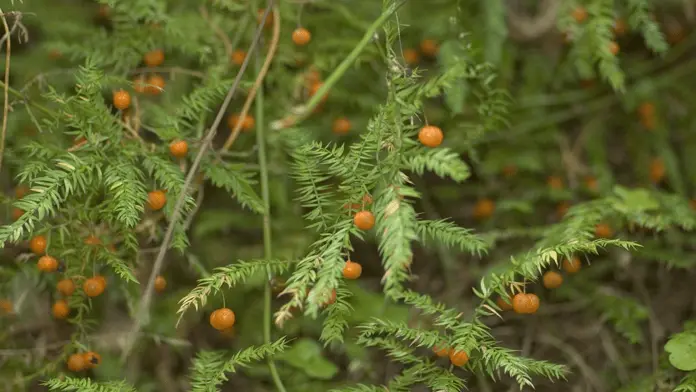
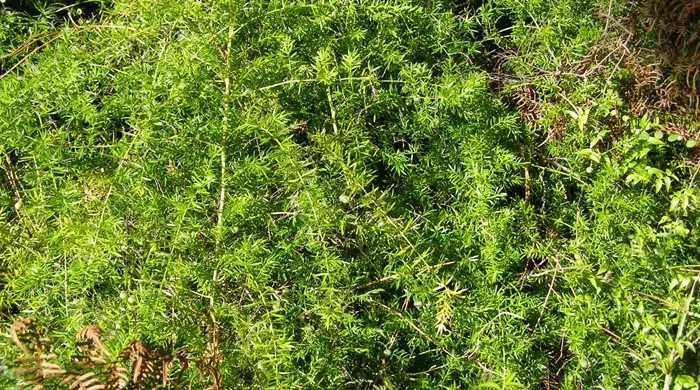
Free control of climbing asparagus (shown above) and bushy asparagus in the buffer zone began earlier this year. There was great support from the community with that first round of control and we’re looking forward to another successful round.
Council will be in touch with eligible residents/owners of properties around Mahurangi Regional Park – please keep an eye out for this correspondence.
For information on the pest plants that are part of this work, and for more information on the programme, please visit www.aucklandcouncil.govt.nz/buffers
The buffer programme is part of Auckland Council’s Regional Pest Management Plan (RPMP). There are rules about management of some pest plants on properties in buffer zones.
When these pest plants are being managed on the park:
Climbing asparagus (shown above) and bushy asparagus – Auckland Council must undertake initial destruction on land in the buffers. Follow up destruction must be undertaken by the land owner/occupier.
Woolly nightshade, moth plant, and wild ginger – Land owners/occupiers of a buffer must undertake destruction of these plants on their land.
Which plant smells like turpentine when its leaves are crushed?
If you guessed woolly nightshade you’re doing well. Its stems are covered in small silica hairs that cause skin irritation too – best to cover up when getting rid of it from your property.
Woolly Nightshade
Solanum mauritianum
A soft leaved perennial herb that can grow up to 3m tall. Small woolly nightshade plants are single stemmed, but become multi-stemmed as they mature.
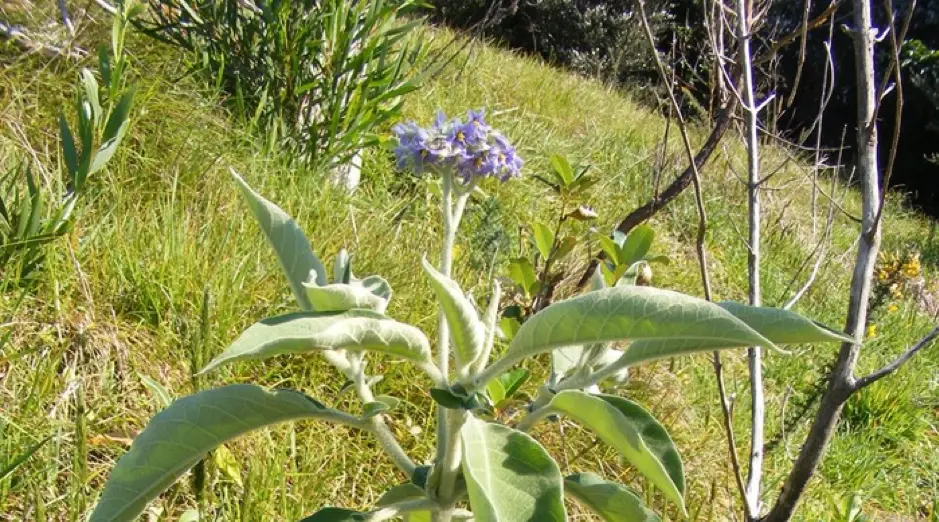
with birds then spreading the seeds across the countryside. [Photo: Auckland Council]
If you occupy land within the buffer area of a park where woolly nightshade is being managed, you must destroy all woolly nightshade on that land.
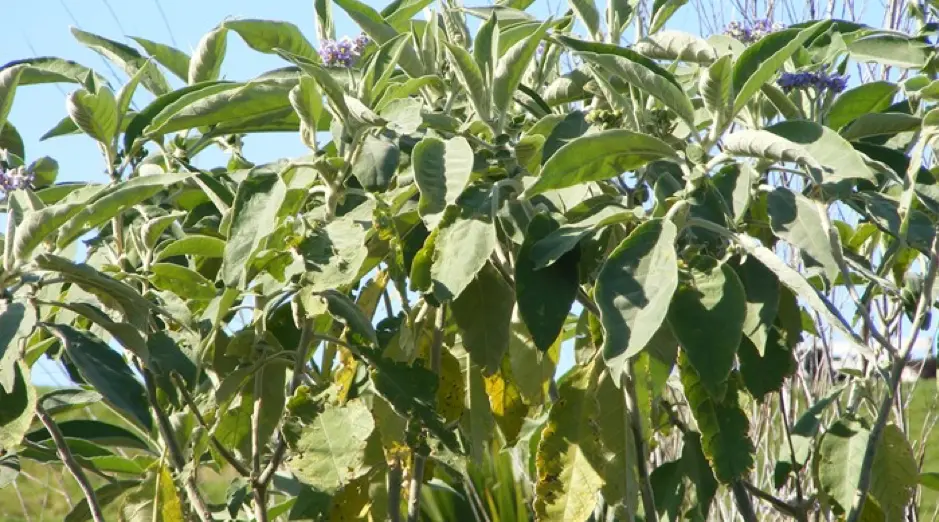
Woolly nightshade only survives in areas where there is no frost. [Photo: Auckland Council]
Control Recommendations
For small stems cut near ground and paste with double strength glyphosate or picloram gel or frill stem and paste fresh cuts with double strength glyphosate gel or picloram gel. Note: Avoid using picloram near streams and wetlands.
Trees are best controlled standing and allowed to breakdown slowly. Follow up treated areas 3 times per year.
Woolly nightshade plants can cause irritation to the throat and skin. Wear a mask and long-sleeved shirt.
Physical control
Dig or pull out. Trunks and stems are slightly woody but easily chopped down with a hand saw.
Seeds require disposal – remove to greenwaste or landfill if practicable.
Cape Ivy
Senecio angulatus
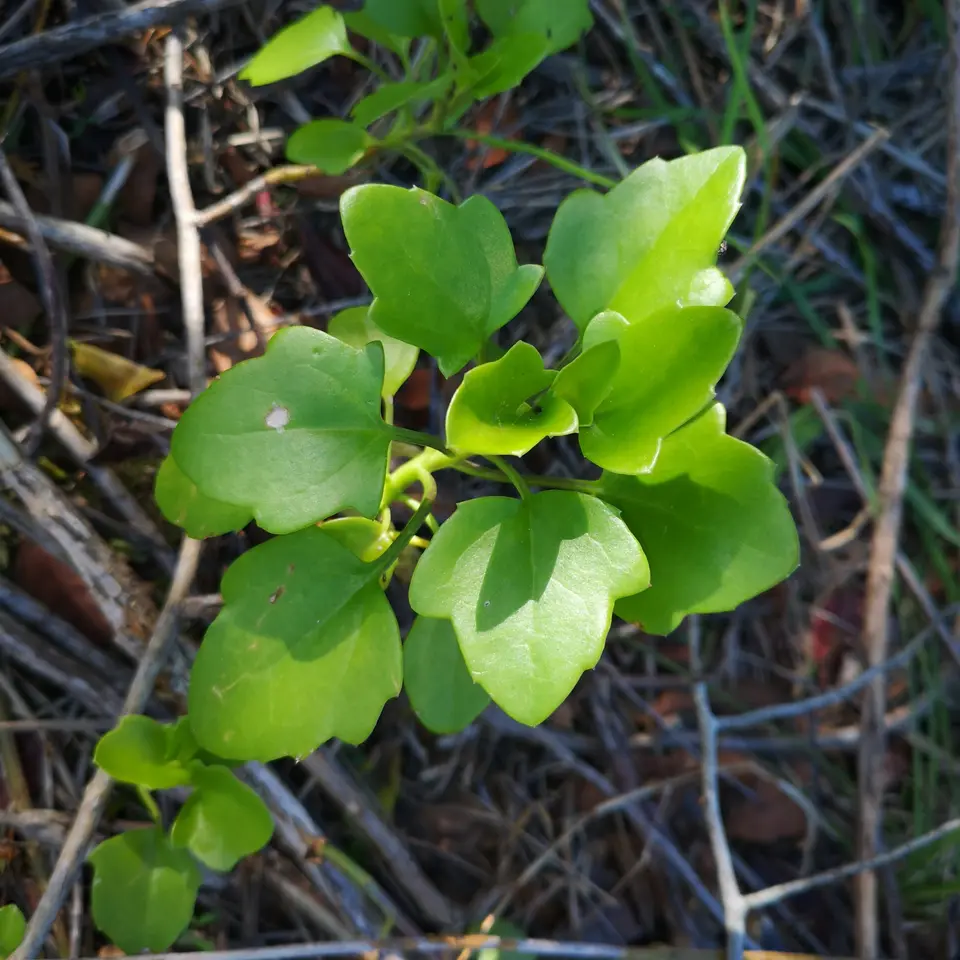
This plant pest belongs to the daisy family. Cape ivy is a scrambling perennial from Africa, that spreads through its fluffy, wind-blown seed. It can form dense mats, smothering plants to 3 metres tall and preventing native seedlings from growing.
It likes waste places, roadsides and the edges of coastal or regenerating lowland forests. It is most easily controlled during flowering and before seed is produced. It’s yellow flowers form in clusters, not unlike ragwort.
Hand pull small plants or dig out roots (all year round), then dispose of at a refuse transfer station, burn or bury deeply.
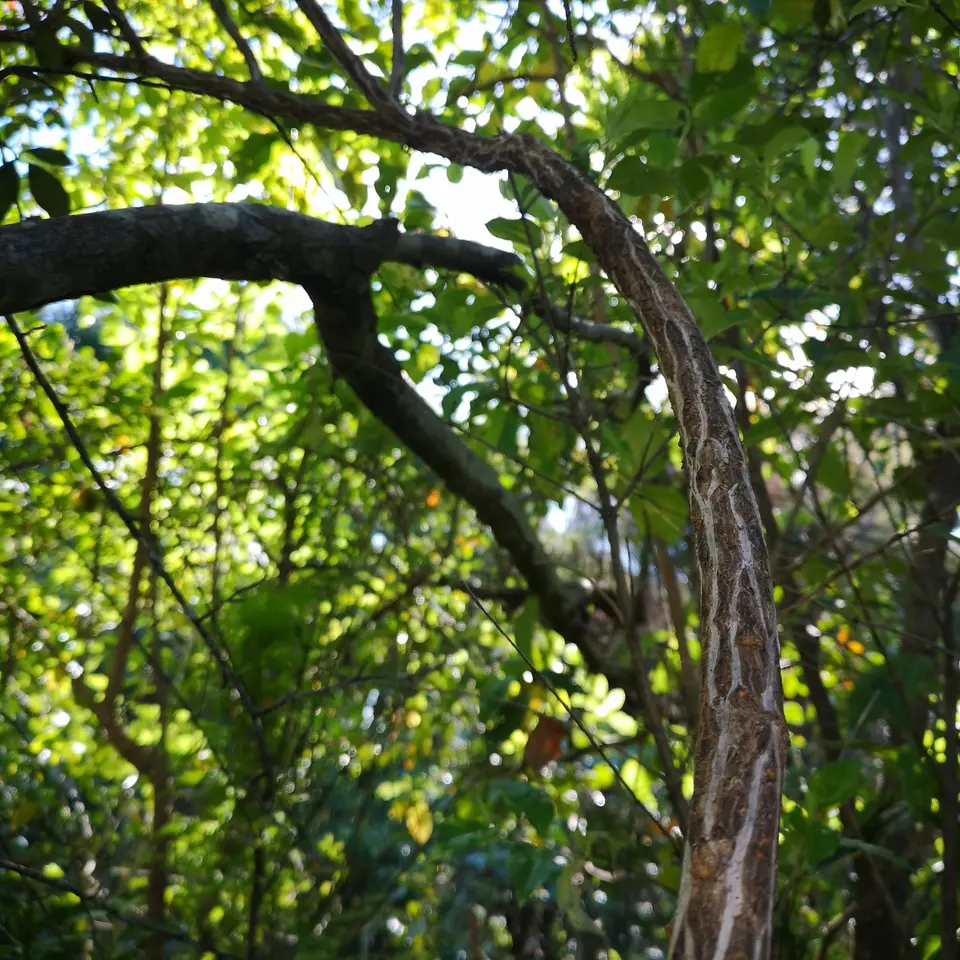
This stem reaching for the light, is high in the canopy before branching. Photo: N.A. Cottrell
To eradicate Cape ivy
Stump swab (all year round): glyphosate (100ml/L) or metsulfuron-methyl 600g/kg (1g/L).
Cut stems below waist height, spray below this point (spring-summer to actively growing plants): glyphosate (10ml/L (knapsack) or 2L/100L (spraygun)) or metsulfuron-methyl 600g/kg (2g/10L (knapsack) or 20g/100L (spraygun)) or a product containing 100g picloram+300g triclopyr/L (60ml/10L) or a product containing 200g 2,4-D+100g dicamba/L (12ml/L) or dicamba 50g/L (24ml/L) or amitrole (150ml/15L (knapsack) or 2L/100L (spraygun)). Add penetrant to all mixes. [Weedbusters]
What can be done to stop it coming back?
Cut out or poison stumps. Remove dropped stems and dispose of as they can resprout. Reseed or replant bare areas.
Climbing Asparagus
Asparagus scandens
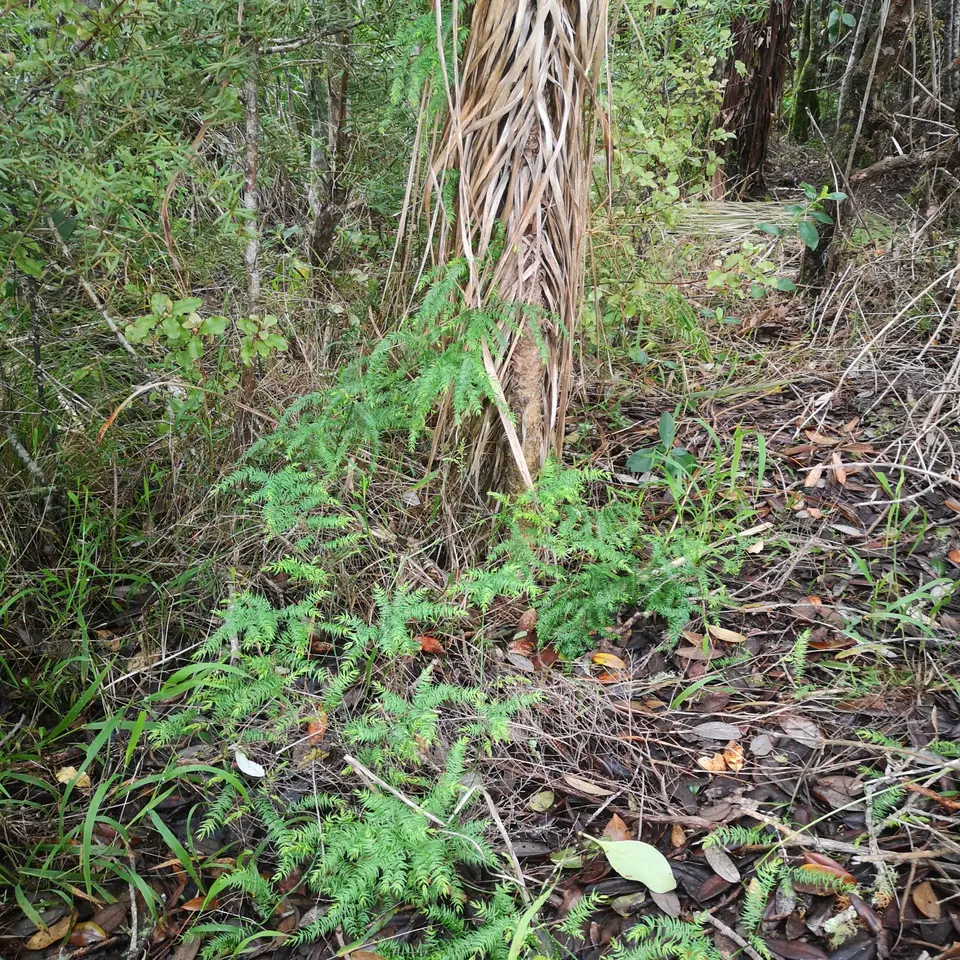
A climbing vine from South Africa with feathery leaves and long wiry stems. The roots are fleshy tubers, which can survive for a long time and will re-sprout easily. Tiny white flowers appear in spring, which are followed by orange-red berries.
The berries can be dispersed over a wide area by birds to form new areas of invasion, and new growth will sprout readily from the tubers. The vine grows in a wide range of conditions including moderate to deep shade, moderate to heavy rainfall, and a wide range of temperatures and soil types, meaning it can invade and grow in most locations.
Climbing asparagus can form dense areas of growth on the ground, and will rapidly grow up plants, smothering the understorey up to a height of 4 metres. The vine can even ringbark trees and shrubs that have soft bark, killing them.
The dense areas of growth on the ground prevents native seedlings from establishing. Larger trees can be smothered and killed. This canopy loss lets more sunlight into the forest understory, which promotes the further invasion of weeds. As the vine climbs up the native trees it takes over areas where epiphytes would normally grow, further reducing diversity of native plants. This destruction of native plants can also contribute to erosion.
Carolyn Lewis, from http://www.weedbusters.org
To eradicate climbing asparagus:
a) Cut growth approx. 50 cm from the ground and leave the upper part of the vine in the tree to die; ensure it is not touching the ground as it could re-sprout. Dig out the tuber and dispose of it to landfill.
or
b) Pull the vine well away from desirable plants and spray with glyphosate (20ml per litre of water) –ensure the spray is directed away from the desirable plant.
Follow up treatments will be required every 3-4 months, so check the treated area for regrowth regularly and respray or dig out tubers that have re-sprouted.
After 2-4 treatments, densely plant the area to minimise risk of re-invasion. Use native plants such as Muehlenbeckia complexa (Pohuehue) or Hen and Chicken fern. Continue to check area for any regrowth.
Bushy Asparagus
Asparagus aethiopicus
A scrambling, multi-stemmed, bushy herb, also known as Asparagus densiflorus and its origin is South Africa. The roots are tuberous and form a thick mat. Flowers are white and borne in October – March.
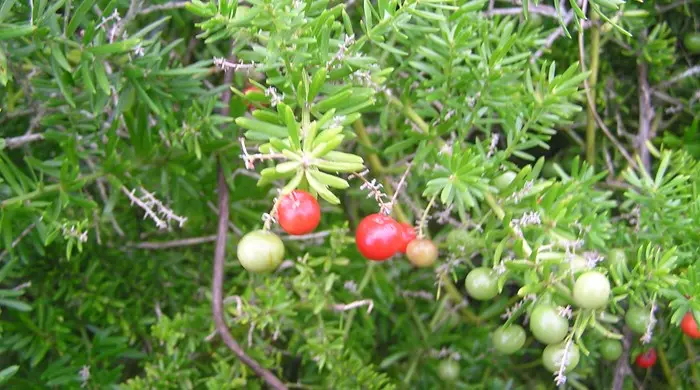
If you occupy land within the buffer zone of a park where bushy asparagus is being managed, and Auckland Council has carried out initial destruction of bushy asparagus on that land, you must undertake follow up the destruction of all bushy asparagus on that land.
Habitats
Forest, scrub, coastal ecosystems, dunes.
Dispersal
Seeds dispersed by birds.
Impact on Environment
Can form dense infestations, excluding native vegetation. May impede recreational access to natural areas.
Control
Cut and pull vines away from desirable trees and native plants before foliar spraying. Follow up treated areas 3 times per year. Encourage natural regeneration of native plants or replant treated areas where possible after 2-3 treatments to establish dense ground cover and minimise re-invasion.
Physical control
Method: dig out.
Plant parts requiring disposal: Tubers, rhizomes and seeds.
Disposal options: Rot tubers, rhizomes and seeds in covered water barrel or remove to greenwaste or landfill if practical.
Community agrichemical control recommendations
With no qualifications: Foliar spray with 200ml glyphosate green per 10L of water.
Certified Handler/Experienced agrichemical user: Foliar spray with 200ml glyphosate green per 10L of water and 10ml penetrant.
Monkey Apple Tree
Syzygium smithii or Acmena smithii
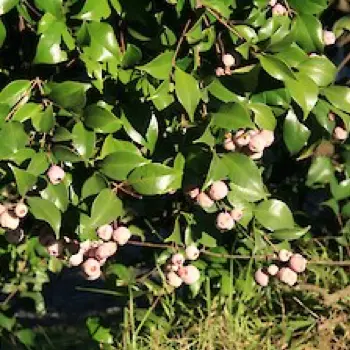
The Monkey Apple is a rapidly growing, long-lived tree, originating from Australia. It has glossy oval leaves and can grow up to 15 metres tall. White to cream flowers appear during October to January, followed by bunches of small white to pinkish/mauve berries.
The berries are favoured by birds which then disperse the seed over wide areas.
Monkey Apple seedlings are shade tolerant and grow more rapidly than native seedlings. They will out-compete natives in the understorey and can form dense stands, altering the forest structure and replacing natives in the canopy.
Monkey Apple trees are hard to kill. Small seedlings can be dug out and left to rot. For large trees fell the tree and paint the fresh stump with Metsulfuron gel. Any fruit present should be removed and sent to landfill as they will germinate freely if left on the ground.
Inspect the treated area regularly (e.g. 6-monthly) to check for any sprouting seedlings. Replant densely with natives such as Titoki (Alectryon excelsus) to inhibit any new growth.
Cotoneaster
Cotoneaster glaucophyllus, C. franchetii and C. simonsii
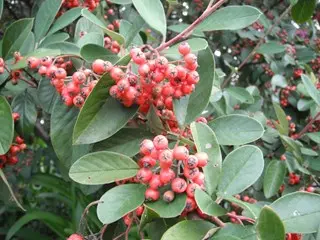
Cotoneaster are small-leaved evergreen shrubs growing up to 4m tall. Small white/pink flowers appear in early summer, and these are followed by orange-red berries which can last on the tree up until mid-winter. Cotoneaster grows in a range of habitats including open scrubland, coastal forest, along road margins and coastal cliff tops. The shrubs grow rapidly to form dense stands, crowding out native plants and stopping native seedlings establishing. Birds love the berries and will contribute to dispersing the seeds over wide areas.
To control Cotoneaster fell the tree and paint the stump with metsulfuron gel 1-2mm thick. Care must be taken when using metsulfuron around non-target plants as they can also be poisoned. Glyphosate is less toxic and can be used as an alternative. If berries are present when felling the tree try to remove these if possible, and dispose to landfill, as they can germinate readily. Check the treated areas several times over the next year for any regrowth or new seedlings.
Replant the treated area after 6-12 months to establish thick ground cover to prevent re-infestation. Suggested native plants to use include Korokia, Karamū and Coastal mahoe.
Moth Plant
Araujia sericifera syn. A. hortorum
This perennial climbing vine has milky sap/latex. Its stems are twining, scrambling and woody. Leaves have dull green tops and grey undersides. Fruit is fleshy, leathery and pear-shaped.
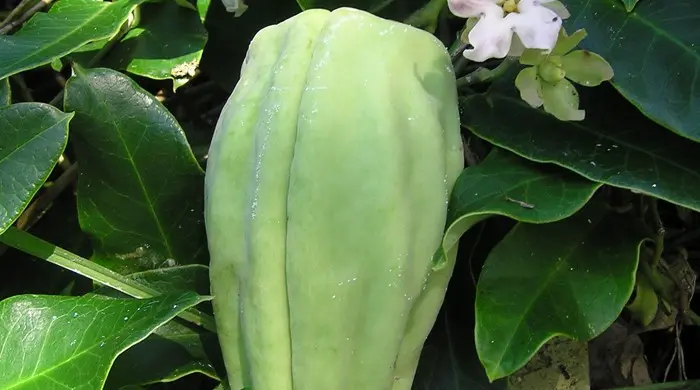
that is poisonous to animals and can sting skin and eyes. [Auckland Council]
If you occupy land within the buffer area of a park where moth plant is being managed, you must destroy all moth plant on that land.
Habitats
Forest, forest margins, tracks, coastline, cliffs, shrublands, mangroves, wasteland, orchards, urban areas.
Dispersal
Seeds dispersed by wind and water.
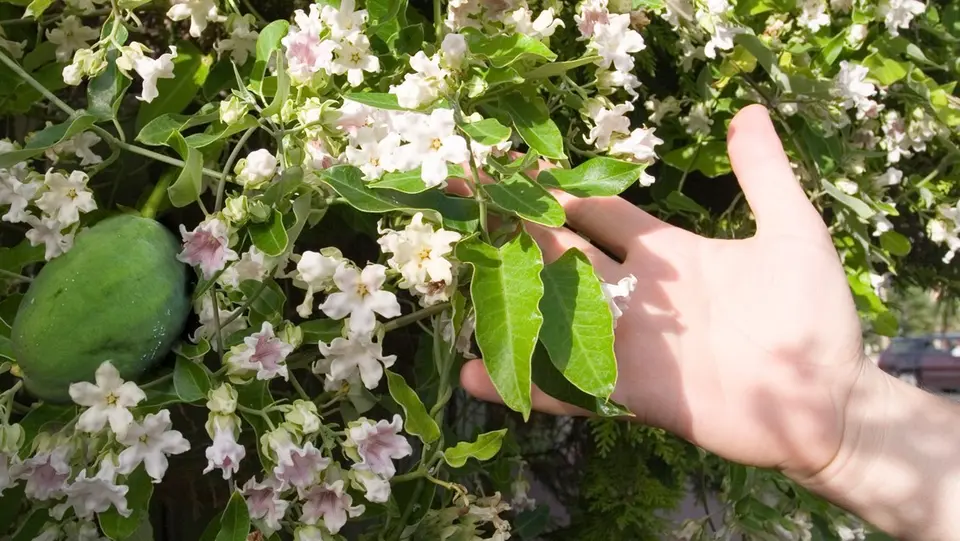
Impact on environment
Smothers native vegetation and prevents recruitment. Potential to catastrophically impact forest structure. Poisonous milky latex in stems, leaves and roots can cause dermatitis.
CONTROL
Site Management
Cut and pull vines away from desirable trees and native plants before foliar spraying. Follow up treated areas 3 times per year. Encourage natural regeneration of native plants or replant treated areas where possible after 2-3 treatments to establish dense ground cover and minimise reinvasion.
PHYSICAL CONTROL
Method: Dig or pull out.
Plant parts requiring disposal: Seed pods.
Disposal options: Remove to greenwaste or landfill.
Biocontrol
Moth plant beetle (Colaspis argentinensis). For more information about how biocontrol works, see What is biocontrol?
Community agrichemical control recommendations
With no qualifications: Cut stump and paste freshly cut base of stems with metsulfuron gel.
Basic Growsafe certified: Cut stump and spray freshly cut base of stems with 1g metsulfuron-methyl per 1 L of water.
Certified Handler/Experienced agrichemical user: Foliar spray with 5g metsulfuron-methyl per 10L of water and 20ml penetrant.
Control requires tracing back all stems to the base stem, cutting it off and applying chemical to the base. All pods should be collected and destroyed safely prior to seeds being released.
Tradescantia fluminensis
Tradescantia fluminensis
Plant Pest: Tradescantia fluminensis
Photo: Carolyn Lewis.
Source: http://www.weedbusters.org.nz
Tradescantia fluminensis, otherwise known as Wandering Willie, is a creeping dark green ground cover that grows happily in light to deep shade. It will form dense mats, smothering native plants and preventing growth of native seedlings. Small white flowers are present in December to January.
The plant is shallow rooted so can easily be pulled out or raked up however it can regrow from any small piece of stem that is left behind. Parts removed can be disposed of to landfill, burnt, or placed in a weed composting bag for 12 months. Or spray the plant with Triclopyr (6ml / Litre of water) with added penetrant. Care must be taken not to spray non-target plants as these can also be killed by this herbicide. Check the area regularly for regrowth as several applications at 2 – 3 month intervals may be required to successfully eradicate the weed. The Auckland Council website also lists some forms of biological control that are available for this weed.
Once eradicated, replant the area with dense ground cover plants (e.g. Nertera depressa or Adiantum aethiopica) to prevent reinvasion.
Plant Pest: Tradescantia fluminensis
Photo: Trevor James
Source: http://www.weedbusters.org.nz
………………………………………………………………………………………………………………………………………………………..
South American Pampas Grass
Cortaderia sellonia and C. jubata
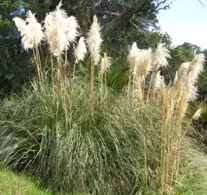
Plant Pest: South American Pampas Grass
Source: pestsearch.aucklandcouncil.govt.nz
South American pampas grass is a large clump forming grass which can grow up to 4 metres tall. It grows rapidly, quickly colonising cleared land to form a dense ground cover that suppresses native plants and stops their regeneration. Pampas grass can become a fire hazard and provides a habitat for rats and other vermin. The plant spreads easily with seeds being blown long distances by winds. Seeds can also be dispersed by water, contaminated machinery or by animals.
South American pampas grass can appear similar to native toetoe, so it is important to differentiate the two before removing the plant. Pampas flowers late January to June with dense, erect flower heads. Toetoe flowers September to January and has drooping flower heads. The dead leaves of pampas forms spirals like wood shavings around the base of the plant, while toetoe does not form these spirals. The leaf base of toetoe is white and waxy whereas the leaf base of pampas is not waxy.
To control pampas:
If small enough, dig out the entire plant including roots and dispose of seed heads and roots to landfill.
Or Fell the plant and paint the cut area with glyphosate gel.
Or Spray entire plant with glyphosate foliage spray.
Check the treated area regularly for regrowth or reinfestation.
Once eradicated replant the area with plants such as native toetoe or Chionochloa species. This will help shade out pampas grass and stop it regrowing.
For photos and further information click on link below:
https://pestsearch.aucklandcouncil.govt.nz/pest-search/Corjub
Wild Ginger
Hedychium gardnerianum and H. flavescens
Also known as Kahili ginger, this is a perennial herb that grows up to 3m tall. Flowers are fragrant and large rhizomes grow underground and above the ground. A perennial herb up to 3m tall. Surface rhizomes are large and branching. Leaves are large and green. Flowers are scented, borne in spikes, yellow with red stamens in H. gardnerianum and creamy yellow in H. flavescens. Fruits are fleshy and orange.
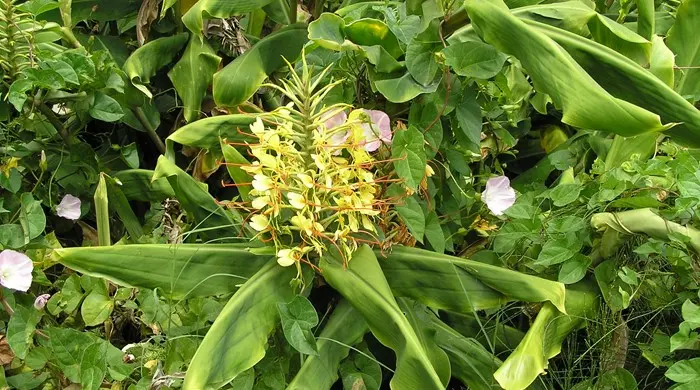
If you occupy land within the buffer area of a park where wild ginger is being managed, you must destroy all wild ginger on that land
Habitats
Forest, forest and riparian margins, shrublands, fernland.
Dispersal
H. gardnerianum seed dispersed by birds. Vegetative spread from rhizome fragments. Human-mediated dispersal through dumping of garden waste.
Impact on environment
Forms dense stands, suppressing native vegetation and preventing recruitment. Potential to change forest composition. May increase erosion and alter decomposition and nutrient cycling patterns.
CONTROL
Site Management
Follow up treated areas 3 times per year. Encourage natural regeneration of native plants or replant treated areas where possible after 2-3 treatments to establish dense ground cover and minimise reinvasion.
Recommended approaches
PHYSICAL CONTROL
Method: Cut stems and dig out rhizomes.
Plant parts requiring disposal: Seeds and rhizomes.
Disposal options: Small amounts can be rotted in a covered water barrel or remove to greenwaste or landfill.
Biocontrol: is currently not available for this species.
Community agrichemical control recommendations
With no qualifications:
For small infestations only: Cut stump and paste freshly cut rhizomes with a small amount of metsulfuron gel.
Basic Growsafe certified: Cut stump and spray freshly cut base with 1g metsulfuron-methyl per 1 L of water. For areas of wild ginger under native forest reduce rates to 0.5g metsulfuron-methyl per 1 L of water.
Caution: When using any herbicide or pesticide please read the label thoroughly to ensure that all instructions and safety requirements are followed.
A fast growing plant that forms large clumps. As wild ginger grows, more and more rhizomes are grown and these can stack up on each other out of the soil.
Very good at producing seed, wild ginger can quickly spread through native bush. Stems and leaves are soft and can easily be cut away.
Wild ginger can grow in low light conditions, expanding through native forests with ease. As the clumps are so dense, native seeds are unable to germinate on the ground.
Care must be taken when controlling ginger to remove all rhizomes as new plants can grow from fragments.
Wild ginger can survive in full sun conditions and the heat and dry. It is found in native forests, roadsides, pine forests, and anywhere that plants have been dumped.
Wild ginger flowers are born on long stems and are yellow with long necks. Orange anthers grow on long stems from the centre of each flower.
Commonly found in areas with other weed species where soil has been disturbed and native vegetation has been removed. Wild ginger can be controlled with herbicide that must be able to penetrate into each rhizome.